Take Notice

TAKE NOTICE:
This regime insists it is only trying to deport “criminals,” yet it is pouring obscene amounts of money into warehouses, tent cities, and what it carefully labels “detention facilities”—a phrase doing Olympic-level rhetorical work to obscure what these places actually are: concentration camps. If the objective were merely deportation, this spending pattern would make no sense. Deportation is a throughput problem: short stays, rapid processing, minimal infrastructure. You move people quickly or you don’t build at all. You do not pour billions into permanent cages to facilitate removal. You build permanent cages to facilitate retention.
That is the contradiction people need to understand. This has never been about deportation. It is about mass confinement. What is being constructed bears little resemblance to an immigration system and far more resemblance to a carceral architecture designed for long-term use: durable facilities, privatized management, opaque oversight, and legal ambiguity baked into the process itself. This is not an endpoint system. It is an intake system.
What is emerging looks far less like immigration enforcement and far more like an Americanized GULAG model: a geographically dispersed archipelago of for-profit run concentration camps designed to disappear people into bureaucratic limbo. Not just those convicted of crimes, but anyone deemed inconvenient, destabilizing, or politically threatening to the regime. Once the infrastructure exists, the definition of who belongs inside it becomes infinitely flexible.
The Soviet GULAG system was never primarily about violent crime. It was a tool of governance used to maintain fear and control. Criminal law functioned as pretext, allowing the state to disappear dissidents, journalists, intellectuals, labor organizers, ethnic minorities, and ordinary citizens under vague or manufactured charges. People were swept up, removed from public view, and broken quietly, often violently, far from public scrutiny.
Modern Russia did not abandon this model. Under Putin, it refined it.
Putin’s system of repression operates through procedure rather than spectacle. Laws are written broadly and ambiguously—covering “extremism,” “foreign influence,” or “discrediting the state”—so nearly anyone can be charged. Enforcement is selective, keeping the public fearful and uncertain. Pretrial detention functions as punishment without conviction, with people held for months or years under the justification of “ongoing investigations.” Courts staffed by loyalists rubber-stamp these actions, rendering judicial review ceremonial. Carceral institutions—prisons, labor colonies, and euphemistically labeled detention centers—normalize abuse while maintaining plausible deniability. The system does not rely on mass executions or show trials. It governs through public attrition, exhaustion, and deterrence, quietly disappearing people into legal limbo. Criminal law is not the point; it is the cover. The objective is total control.
Now line that up with what we are watching right now in America under Trump’s regime:
1.) Indefinite detention justified through emergency authority.
2.) Vague or elastic charges expandable at will.
3.) Euphemistic language that turns violence into administration.
4.) Centralization of executive power.
5.) Political opposition reframed as a security threat.
6.) Law enforcement treated as an instrument of loyalty rather than a neutral institution.
These are not random developments. They are sequential steps.
Authoritarian systems do not begin with overt tyranny. They begin with a normalization process. Each move is framed as temporary, necessary, or targeted at “bad people.” Each expansion of power is justified by manufactured crisis. Each erosion of civil rights is sold as a trade-off for safety. Over time, confinement without trial, punishment without conviction, and surveillance without oversight become treated as unfortunate but reasonable.
Putin’s Russia has perfected this rhythm over the past quarter-century. Crackdowns on dissent are framed as security measures. Media restrictions are justified as anti-disinformation. Arrests of political opponents are portrayed as routine law enforcement. Everything is done “by the book,” even though the book has been rewritten beyond recognition.
Now look again at America under Trump’s regime. Project 2025, the Heritage Foundation’s agenda, and Trump’s second-term rhetoric track disturbingly close to this template:
1.) Expanded detention capacity and executive authority.
2.) Attacks on judicial independence and the press.
3.) Criminalization of protest.
4.) Recasting political opposition as internal sabotage.
5.) Loyalty elevated above legality.
6.) Normalization of the idea that some groups do not deserve full constitutional protection.
These are the same mechanics.
Putin has every incentive to encourage this trajectory. His regime benefits when democratic norms collapse elsewhere. When democracies mimic authoritarian practices, it validates his model and weakens global resistance to it. He does not need to control another country directly; he only needs its institutions to rot from the inside. The more “law and order” rhetoric is used to justify repression, the easier it becomes to argue that liberal democracy was always a sham.
It is therefore entirely plausible that Trump’s regime is drawing—formally or informally—on Russian expertise in authoritarian governance. Not through dramatic spy-movie coordination, but through quiet consultation, shared security doctrines, informal exchanges, and the circulation of “best practices.” Russia has decades, centuries even, of experience refining domestic repression while maintaining the appearance of legality. That expertise is valuable, and it appears to be getting used right here in the United States.
Protest suppression tactics in the U.S. increasingly resemble Russian methods not just in outcome, but in execution. In Russia, crowd control units are trained not to de-escalate but to escalate violence and dominate: kettling before crowds form, seizing people at random to create uncertainty, violently beating detainees out of public view, and holding them under vague charges that punish without any trial. The goal is not order, but deterrence of dissent through fear and exhaustion.
In America, protest policing deployed by ICE and CBP is blatantly beginning to mirror this playbook. Militarized units replace civilian policing. Mass arrests occur without individualized cause. Demonstrators, even those killed, are labeled extremists or domestic terrorists. Detention becomes preventative rather than judicial. Visibility disappears the moment someone is taken off the street.
The same logic governs detention policy more broadly. Russia relies heavily on pretrial incarceration as punishment, with courts serving as formalities rather than safeguards. Whether through formal channels or informal networks, it is reasonable to conclude that Trump’s regime is adopting similar methods to suppress dissent, fracture civil society, weaponize law enforcement, and normalize mass detention without triggering immediate public revolt.
This leads to an unavoidable conclusion:
America is being terrorized and hijacked by someone who behaves like a Putin asset in function, whether or not that relationship is formalized.
Trump is betraying the Constitution itself. That betrayal aligns perfectly with the interests of a foreign authoritarian power that thrives when democratic institutions rot quietly rather than collapse dramatically.
This is not coincidence or improvisation. It is an authoritarian blueprint being applied in plain sight. At some point, continuing to pretend otherwise stops being skepticism and becomes a choice.
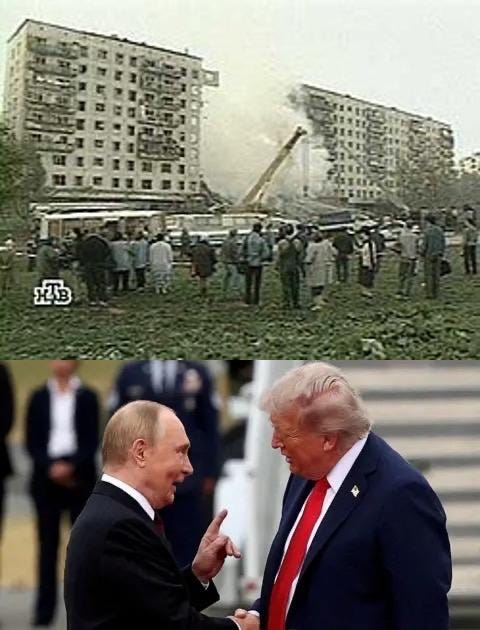
If you want to understand the evil Trump appears to be following, consider Putin’s rise. In 1999, a series of apartment bombings across Russia killed roughly 300 civilians. The attacks were officially blamed on Chechen militants and used to justify sweeping domestic repression and the Second Chechen War—consolidating public support for expanded state power and rapidly accelerating Putin’s ascent. Subsequent evidence and credible investigations strongly suggest the bombings were not the work of Chechen militants at all, but were instead orchestrated by Russia’s own security services. In the city of Ryazan, residents discovered sacks of hexogen explosives planted in an apartment basement; local authorities initially treated the incident as a genuine terrorist attack, only for the FSB to later claim it had been a “training exercise.” Former FSB officers and independent investigators have since alleged that the apartment bombings were a false-flag operation carried out by the FSB itself. At the time, Putin was a former FSB director, deeply embedded in the very security apparatus that would soon become the backbone of his regime.
So perceptive and accurate, and very important to bring this truth to light on this topic, thank you very much, Ollie. It's absolutely APPALLING. Such horrible, hideous people in power now in the US.
It’s no coincidence that many/most of these are privatized and allow money to flow to private equity. In addition, the “need” for immigration detention centers will soon become less and less. They are building them to imprison citizens and legalized immigrants: for protesting, for being poor and homeless, for being unemployed, for not being white.